In Conversation with Brian Eno: Relaunching Opal Records, Music for Airports, AI Risks, and Palestine
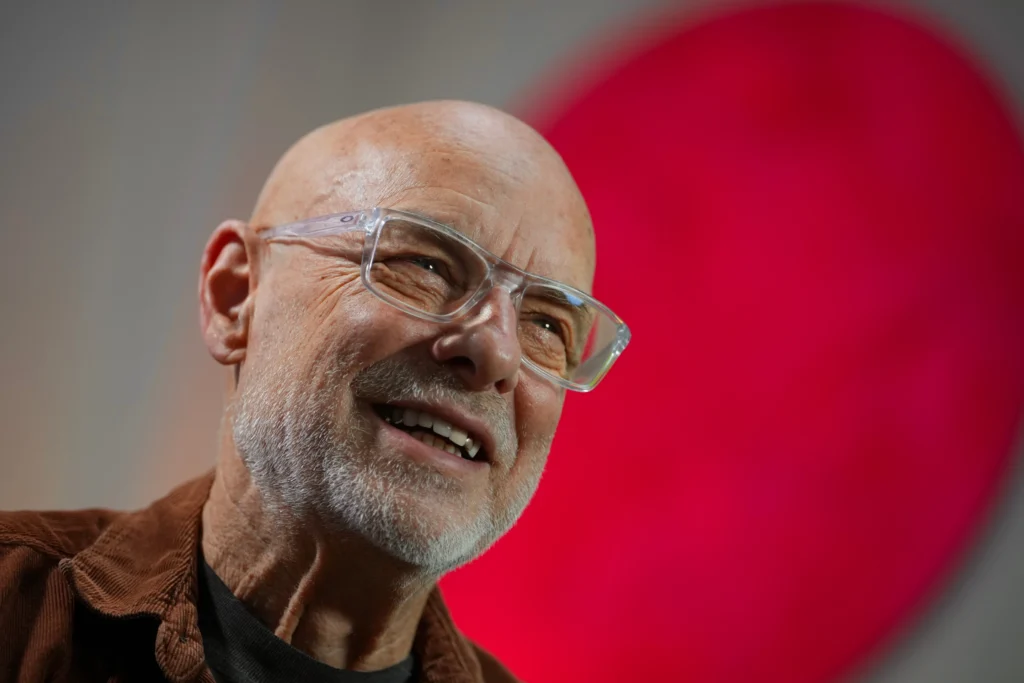
Multifaceted artist, producer, and political activist Brian Eno—celebrated worldwide for pioneering ambient music—is officially reviving his iconic record label, Opal Records. Originally launched in 1988 before halting operations in 1991, Opal served as an home for experimental music pioneers, including Jon Hassell, John Cale, and Eno himself.
Sitting down in his personal home recording studio, the legendary innovator opened up about why now is the time to resurrect Opal, his thoughts on the rise of artificial intelligence, his connection to Palestinian history, and why he’s nowhere near ready to retire.
On Relaunching Opal Records & Unreleased Archives
Q: Why bring back Opal Records now?
Brian Eno: One simple reason is that two of Opal’s albums essentially disappeared, and I wanted to re-release them (2005’s “Another Day on Earth” and 2001’s “Drawn From Life”, both notoriously hard to find outside Japan).
Beyond that, I’ve been thinking about releasing a 12-album collection. I have so much unreleased music sitting around that actually fits together really well. It’s functional music—the kind of music you put on when you’re reading or cleaning your room, creating a specific atmosphere. Now I can just put it out without having to persuade anyone else.
Q: Your landmark album Music for Airports has been around for nearly five decades. Why does it still resonate so strongly today?
Brian Eno: It’s fascinating to me that Music for Airports is 48 years old and still selling. Young people still discover it and assume I just released it!
I think its longevity comes from its simplicity. Most music is dated by specific production techniques or stylistic markers—you can usually spot an 80s pop record instantly just by the snare drum sound. Music for Airports lacks those distinct era-stamps. It could have been made today. In fact, people are probably making their own versions of it right now—maybe calling it Music for Trains or Music for E-Bikes.
On Artificial Intelligence and Corporate Greed
Q: When Opal first launched, AI wasn’t part of the conversation. How do you view AI’s role in music today?
Brian Eno: I’m fascinated by the creative possibilities of collaborating with AI. My real concern isn’t the technology itself, but its ownership and the moral values of the people controlling it. The tech giants running AI are arguably the least qualified people to hold such powerful tools. Because they’re driven purely by profit and competition, they care about winning corporate races rather than benefiting society.
The evolution of any technology during its formative years is critical, and public involvement is essential. Otherwise, we end up in the absurd position we’re in now—where AI agents possess intelligence far beyond the comprehension of the general public, and even their own developers. It represents a massive failure of regulation.
On Palestine and Political Stances in Music
Q: You organized a solidarity concert for Palestine last year. What did you make of the recent controversy where rapper Macklemore was removed as an opening act on Ed Sheeran’s tour after making pro-Palestinian comments on stage?
Brian Eno: The real blame lies with the decision-makers who refused to let the show go on. That said, I thought Ed showed weakness there. He could have stood his ground and said: “I’m an artist. You hired me as an artist, which means I decide who is in the band and who shares the stage with me.”
To be fair, it’s an extraordinarily tough position when thousands of fans have already bought tickets, booked travel, and reserved hotels. It wasn’t an easy choice for him. But he still should have taken a stand.
I was born on May 15, 1948—the day of the Nakba, when Palestinians were forcibly displaced from their homes and told they no longer belonged. Because of that shared date, I’ve felt a deep, lifelong connection to that history.
On Music Legacy and Future Plans
Q: With decades of groundbreaking work behind you, do you think much about your legacy?
Brian Eno: Not unless a specific occasion forces me to! Recently, someone asked me about working with David Bowie in Berlin and France during the late 70s. I thought, “Alright, let me try to answer that.” Digging up those memories was surprisingly enjoyable, but I don’t spend my day-to-day looking back. There’s too much happening in the present. Maybe I’ll reflect when I’m actually old.
Honestly, the to-do list keeps growing. I’d love to retire, but I wouldn’t know what to do with myself!
Q: No bucket list items left?
Brian Eno: The only thing I’ve always wanted to do but never have is soak in a warm bath of olive oil!
In all seriousness, I’ve never been a goal-oriented person. I care much more about how things come into being than the end result. It’s all about the methodology for me—I just love inventing new ways of doing things.
What’s your favorite Brian Eno album, and how do you feel about the intersection of AI and music creation? Share your thoughts in the comments below!