The youngest Secretary of the Army bypassed the chain of command to lodge a complaint, then promptly walked away.
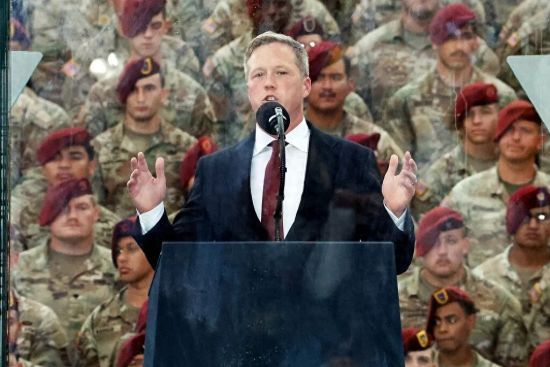
Before submitting his resignation, U.S. Secretary of the Army James Driscoll went straight to President Trump, bypassing his direct supervisor, Defense Secretary Pete Hegseth, to lodge a complaint.
According to The Atlantic, Driscoll recently told Trump that Hegseth’s massive personnel purge had depleted leadership talent in the largest branch of the U.S. military, severely dragging down combat readiness and the transformation process. Trump was reportedly “surprised” upon hearing this.
The Washington Post reported that Trump tried to persuade Driscoll to stay on until the midterm elections, but the youngest civilian head in the history of the U.S. Army was determined to leave.
Following the announcement of his resignation, a White House spokesperson praised Driscoll as “highly effective” in advancing Trump’s agenda, specifically noting his emphasis on “readiness and lethality” and the role he played in Russia-Ukraine negotiations. In a public statement, Driscoll praised Hegseth’s role in the Army’s modernization process and called serving as Secretary of the Army “the honor of a lifetime.”
This spring, Army Chief of Staff General Randy George was dismissed by Hegseth. Since then, the largest branch of the U.S. military has been without a Senate-confirmed military chief. With Driscoll officially “hanging up his boots” on September 3, the U.S. Army has plunged into an unprecedented leadership vacuum.
One of Driscoll’s potential successors is Sean Parnell, a confidant of Hegseth and chief Pentagon spokesperson. Not long ago, Parnell fired three journalists from the U.S. military newspaper Stars and Stripes on the grounds of “insubordination,” a move widely seen as retaliation for the paper exposing the living and health crisis aboard the USS Lincoln, an aircraft carrier that participated in operations against Iran. Parnell declined to comment on whether Hegseth forced Driscoll out, emphasizing that any claims of Hegseth hindering the modernization of the U.S. military were “complete fabrications.”
Open Rupture
Until recently, Driscoll was viewed as one of the most likely successors to Hegseth. Since this spring, Hegseth has been locked in constant friction with Congress over his support for launching a war against Iran and accusations that he covered up damaged equipment and logistical support issues within the military. Compared to the radical and aggressive Hegseth, Driscoll is more moderate and polished, building extensive networks across both the White House and Capitol Hill. It was widely believed that if Hegseth completely lost Trump’s trust, Driscoll would likely take over the Pentagon.
Born in 1986, Driscoll comes from a three-generation Army family and served in Iraq as a junior officer. While studying at Yale Law School, he formed a close friendship with fellow veteran JD Vance. This relationship gave him a direct line to the West Wing and allowed him, to a certain extent, to act as a counterweight to Hegseth.
According to The Wall Street Journal, shortly after Trump took office last year, Driscoll proposed arranging for Vice President Vance to meet with soldiers alongside Trump to discuss Army reforms. Upon learning of this, Hegseth flew into a rage, warning Driscoll not to overstep his bounds. The Washington Post reported that Hegseth was quite dissatisfied with his rival’s expanding portfolio. Not only was Driscoll dispatched by Trump to mediate peace talks in Ukraine, but he also served concurrently as the acting director of the Bureau of Alcohol, Tobacco, Firearms and Explosives (ATF).
Reports of fierce turf wars between the two over Army personnel appointments frequently made headlines starting in the second half of last year. In April of this year, their conflict burst into the open. At the time, Hegseth relieved Army Chief of Staff Randy George of his duties. Driscoll and General George had jointly promoted the “Army Transformation Initiative,” a plan that drew lessons from the battlefields of Ukraine to accelerate weapons procurement and widely deploy cheap drones within the Army. Driscoll later told Congress that General George was a leader “capable of driving change.” On the day George was dismissed, Driscoll personally visited him to offer comfort.
Following General George’s departure, the Army began downsizing a drone unit jointly supported by him and Driscoll, converting it back into a traditional infantry unit. Shortly thereafter, Four-Star General Christopher Donahue, who commanded U.S. Army forces in Europe and Africa, was also forced out. In late August, ignoring Driscoll’s objections, Hegseth blocked four Army colonels who had served under these commanders from being promoted to brigadier general.
Hegseth’s animosity toward the Army’s senior leadership is rooted in his military background. He served in Iraq and Afghanistan and was later “kicked out” of the Army National Guard amid allegations of white supremacist leanings. After taking charge of the Department of Defense, he launched a massive purge of the Army, further intensifying conflicts with military brass and Congress. When Hegseth took office in January 2025, the Army had 10 active-duty four-star generals; today, only 5 remain, dropping to a multi-decade low. Following Driscoll’s resignation, Senator Jack Reed, the ranking Democratic member of the Senate Armed Services Committee, warned that Hegseth had “hollowed out” the Army leadership.
Ever since General George was ousted, the position of Army Chief of Staff has remained vacant, with Vice Chief of Staff General Christopher LaNeve serving in an acting capacity. According to media reports, LaNeve frequently bypasses Driscoll to report directly to Hegseth. While Hegseth intends to formally nominate LaNeve to lead the Army, he has been unable to secure sufficient Republican support in the Senate, leaving the confirmation process stalled. This situation is extremely rare: normally, nominations for top military branch leaders receive unanimous or near-unanimous support in the Senate.
Among those blocking LaNeve’s confirmation is Iowa Republican Senator Joni Ernst. Last fall, Ernst agreed to support LaNeve as Vice Chief of Staff; in exchange, Hegseth promised to let fellow Iowan General George complete his original term, which was set to end in mid-2027. After George was fired, Ernst called Trump to express her displeasure. According to The New York Times, Trump explained that it was Hegseth’s decision, saying, “Please tell the General I’m sorry.”
A Torrent of Leaks
For Hegseth, the past month of August was fraught with turmoil.
According to The Washington Post, multiple senior U.S. military leaders expressed “non-concurrence” in internal assessments regarding the extension of troop deployments in the Middle East. They explicitly warned that large-scale military operations against Iran were rapidly draining U.S. military resources and weakening the force’s ability to defend the American homeland and counter threats in other regions.
The U.S. war against Iran has been ongoing for over half a year, with more than 50,000 U.S. troops still stationed in the region. Hegseth recently ordered the deployment of some Middle Eastern forces to be extended through September, while others are set to remain until 2027.
The clustering of “non-concurrence” opinions is not a mutiny, but rather a formal mechanism for U.S. military leaders to express their professional judgment to civilian leadership: dissents are put on record, but orders are still executed. It is not uncommon for the military to voice dissent; what makes this notable is the number and rank of the dissenters. According to reports, the commanders of the European Command, Indo-Pacific Command, and Southern Command, as well as the Chief of Naval Operations, formally opposed the deployment extensions. While Army and Air Force leadership agreed to the orders, they similarly warned of significant risks involved.
Rather than responding to these warnings, Hegseth instructed his spokesperson to lambor the media for leaking classified information. Pentagon spokesperson Parnell’s statements were even more contradictory: he claimed the reports were “inaccurate” while simultaneously accusing the disclosure of this “highly classified assessment” of being a crime and a “betrayal” of the military.
Recent months have seen a continuous string of Pentagon leaks. In July, Hegseth announced a joint task force with the Department of Justice to track down and prosecute leakers. Yet since then, the classified Secretary of Defense Book of Orders containing warnings on Iran has still been leaked; internal disputes between Trump and Hegseth over depleted ammunition stockpiles have been made public; and detailed accounts of Driscoll’s final meeting with Trump have also appeared in media reports. Analysts point out that when the Pentagon begins leaking information involving vital national security secrets, it usually means internal problems have become extremely severe, and the reality may be even worse than what is revealed in the media.
Whether this round of turmoil will ultimately weaken Hegseth or instead consolidate his power remains an open question. For now, he still enjoys Trump’s backing. Media reports indicated that Trump previously reprimanded Hegseth severely for concealing dwindling ammunition reserves. However, Trump subsequently stated publicly that he was “extremely satisfied” with Hegseth’s work, dismissing reports of tension between the two as “treasonous” talk.