Ring cameras go mobile: Amazon introduces AI-powered security drones and robots
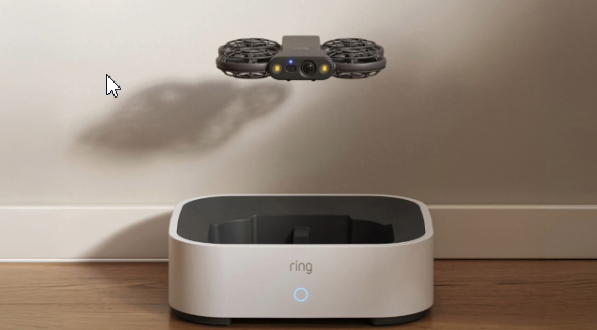
Amazon is betting that many Ring users will also want AI-powered security drones and robots to patrol their homes or offices. However, the company’s upcoming “Ring Robotic” products are bound to reignite privacy concerns—the same concerns that arose when Amazon previously attempted to promote flying security cameras.
According to an announcement from Amazon on November 10, the Ring Rover Cam and Ring Drone Cam are expected to begin shipping to customers in late 2026 and early 2027, respectively. Amazon states that these devices rely on an “AI Pilot” system, which utilizes each device’s onboard cameras—along with specialized vision models, local sensors, and cloud processing—to map out patrol routes while autonomously navigating around obstacles like furniture.
Both devices use the AI Pilot system to generate floor plans of a customer’s home or business. This setup process occurs after a user carries the Ring drone through their indoor space or allows the Ring Rover to explore the area autonomously.
The AI Pilot can reportedly use data from these guided or self-guided tours to identify specific rooms and suggest patrol points near sensitive locations, such as side doors, windows, or even cash registers in a commercial setting.
However, beyond the existing concerns surrounding stationary Ring cameras—whether mounted in the corners of rooms or used as doorbell cameras—these AI-enabled flying and mobile cameras could introduce new privacy risks for homes and businesses.
The Ring Drone
Amazon’s Ring Drone appears to be a direct successor to the company’s “Ring Always Home Cam,” which was released in September 2021 as a limited-availability, invite-only “Day 1 Edition” product—it even shares the same starting price of $250.
Before it can officially hit the market, the Ring Drone must still receive authorization from the U.S. Federal Communications Commission (FCC). If approved, Amazon plans to begin sales on January 27, 2027; customers can currently sign up for email updates via the product page.
This drone can reportedly fly along preset routes and schedules for users subscribed to Amazon’s Ring Protect service. It can also automatically navigate along these preset paths when triggered by notifications from Ring cameras, sensors, or alarms.
The onboard camera has a 148-degree wide-angle field of view and a 360-degree rotation function, and the video resolution is 2K. In the case of insufficient light, the two LED lights will automatically turn on to assist in illuminating the shooting scene of the drone camera.
However, even when operating with “new, fully charged batteries and under controlled conditions,” the drone’s flight time is only eight minutes, according to the product description. It comes with a charging base.
There’s also a caveat in the product description that the Ring Drone Cam’s performance may degrade when navigating environments with reflective surfaces (such as “polished marble or wet tiles”), blank matte walls with no features, or transparent surfaces (such as frameless glass and mirrors).
Still, Amazon claims the drone offers an “unprecedented way to autonomously view your home,” no matter where the user is. Ring drones can be controlled directly through the Alexa Home Map interactive map, which displays an interface across all of a user’s connected Amazon devices.
Roaming Robot
Meanwhile, Amazon has introduced the $1,000 Ring Rover Cam, positioning it as an “autonomous security robot designed for businesses.” The product is now available for pre-order, with shipments expected to begin on December 16, 2026.
The company stated that the design of the Ring Rover was inspired by customer feedback on another product—the Amazon Astro robot, an invite-only beta device intended for home monitoring.
While patrolling or performing 360-degree scans at designated locations, the Ring Rover can stream and record video in up to 4K resolution. Footage triggered by events such as doorbell presses, motion detection, or “Live View” sessions is stored in the cloud—available for sharing and playback for up to 180 days.
Much like the Ring Drone, the Ring Rover can automatically respond to alerts from connected Ring devices and follow pre-set patrol routes. However, as this wheeled robot cannot climb stairs, it is limited to single-level indoor environments.
Amazon’s product description also notes that the Rover is incompatible with “curved edges, recessed areas, floor transitions greater than 1.375 inches (3.5 cm), and glossy black flooring.”
To compensate for its ground-level perspective, the Ring Rover is equipped with an automatically adjustable mast, allowing it to scan over counters, shelves, and other obstacles. According to Amazon’s product description, it can cover an area of up to 5,000 square feet (465 square meters).
The Ring Rover also includes additional security-related features, such as a siren and a light tower that can audibly and visually signal its presence. Furthermore, it is equipped with a microphone, enabling two-way audio communication between users and people near the robot.
Growing Privacy Concerns
Amazon claims that its new Ring Robotics products offer “uncompromising privacy and security,” featuring LED indicators and on-screen notifications to alert users whenever video or audio recording is active. However, Ring—an Amazon subsidiary—has previously been embroiled in several privacy and security scandals.
In 2023, Ring faced an investigation by the U.S. Federal Trade Commission (FTC) for allowing employees and contractors to view video footage captured inside customers’ private spaces. The FTC also noted that Ring’s weak security measures enabled hackers to compromise the accounts of 55,000 U.S. customers.
According to Amazon, video captured by the new Ring drones and the “Ring Rover” will be protected by a “discard-the-key” encryption method, set to be introduced in September 2026. The Electronic Frontier Foundation (EFF), a non-profit organization advocating for digital rights, views this as an improvement over Ring’s previous default settings—though it still falls short of true end-to-end encryption.
The EFF has also criticized the “surveillance-first, privacy-last” approach championed by Ring founder Jamie Siminoff. This includes the company’s decision to reinstate a feature that allows law enforcement to request access to footage or live streams from users’ home security devices.
Amazon’s earlier product, the “Ring Always Home Cam” drone, also sparked significant privacy concerns. Ryan Calo, a researcher in law and technology at the University of Washington, pointed out that such flying surveillance cameras not only create new avenues for indoor monitoring but also make it easier for corporations to obtain potentially sensitive or personally identifiable information from residential and commercial properties.
There is currently no indication that the new Ring Robotics products will utilize facial recognition or similar AI-based identification technologies. However, as of December 2025, Ring has allowed users of its stationary doorbell cameras to enable a “familiar faces” feature—which uses facial recognition to identify visitors—a function that has already triggered a class-action lawsuit.